
What happens between having political opinions and casting a vote?
At first glance, the answer may seem simple. But researchers working within the European City² (EC²) project believe the process is far more complex – and potentially measurable.
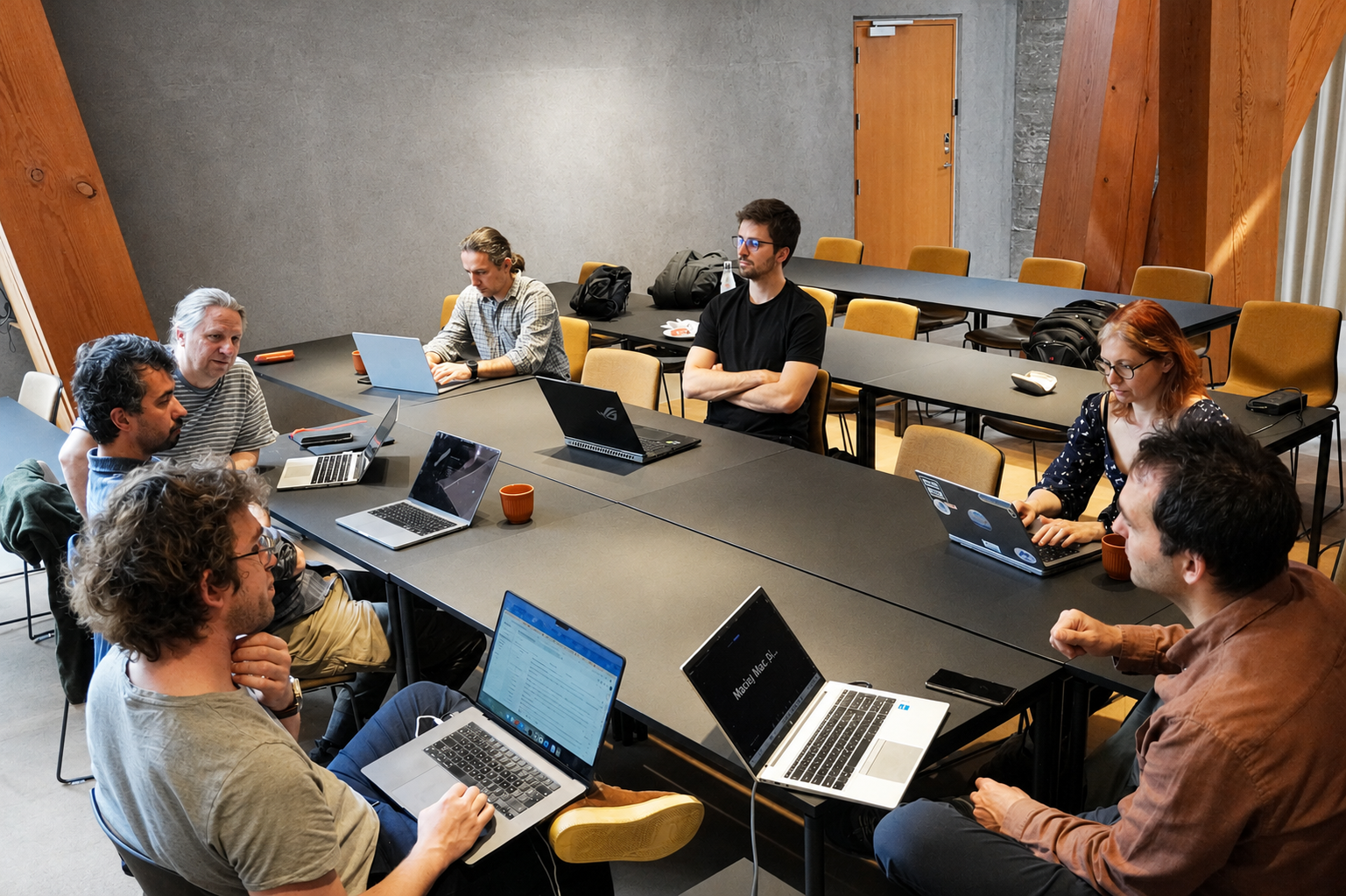
During the EC² General Assembly held on 12–13 May 2026 in Aarhus, Denmark, the project’s Simulation Team presented major progress on “Model Five”, an ambitious framework designed to simulate how democratic decisions emerge from individual preferences, beliefs, media influence, and voting systems.
The discussions revealed a fascinating challenge at the heart of the project: can democracy itself be simulated without oversimplifying human behaviour?
From Preferences to Votes
Model Five is being developed as a decision-making framework that converts individual political preferences into election outcomes using different voting systems.
At the centre of the model is a “collapse function” – a mechanism that transforms many different preferences into one final voting decision for each simulated citizen.
This reflects a real-world democratic problem. People rarely vote based on a single issue. One voter may simultaneously care about housing, healthcare, taxation, climate policy, migration, and public transport. The question is: how do all these priorities eventually become one final choice at the ballot box?
To explore this, the EC² framework already supports multiple democratic systems, including:
- standard majority voting,
- ranked choice voting,
- quadratic voting.
The model also distinguishes between what citizens want and what they believe about the world around them. Preferences and beliefs are both used to weight voting decisions, allowing researchers to model political behaviour in a more realistic way.
For local elections, the framework currently works with 10–11 preference dimensions derived from survey data. For national elections, researchers are testing simplified structures based on five political topics with three questions assigned to each topic.
Simulating How People Actually Decide
One of the most important discussions in Aarhus focused on how citizens “collapse” many political opinions into one final vote.
The team explored three different approaches:
- single-issue voting, where one dominant issue drives the decision,
- mean-based matching, where all preferences are averaged equally,
- weighted matching, where more important preferences receive greater influence.
Researchers also introduced a stochastic element into the framework. When candidates occupy very similar positions in the political preference space, simulated agents may randomly switch choices, creating variability closer to real human behaviour.
The framework can already operate both on detailed candidate-level elections – including more than 200 candidates in Aarhus – and on broader party-level systems.
Why Quadratic Voting Is So Interesting
One of the most innovative elements of Model Five is its implementation of quadratic voting.
In traditional elections, every citizen usually casts one vote. In quadratic voting, people can distribute multiple votes depending on how strongly they support an issue or candidate. However, each additional vote becomes progressively more costly.
Inside the EC² simulation, agents allocate votes based on preference alignment and confidence levels.
This allows the framework to explore not only what voters support, but how intensely they support it. For researchers, this opens new possibilities for studying how alternative democratic systems could influence collective decision-making and representation.
The Debate: Simplicity or Full Behavioural Complexity?
One of the biggest scientific debates during the General Assembly concerned active inference.
A full active inference system would require simulated agents to predict future political outcomes, estimate consequences of voting, continuously update beliefs, and strategically adapt behaviour.
While this would create highly advanced simulations, the team also recognised the risks: such models are computationally demanding, data intensive, and extremely difficult to validate scientifically.
The consortium therefore decided to begin with a simpler proximity voting approach, where agents mainly support candidates closest to their own preferences.
Importantly, this does not mean reducing the project’s ambitions. Quite the opposite. The EC² team deliberately chose to modularise the framework by separating:
- preference formation,
- belief dynamics,
- voting mechanisms.
This structure allows researchers to validate each component independently while creating a flexible scientific foundation for more advanced democratic simulations in the future.
Avoiding One of AI’s Biggest Problems: Overfitting
A recurring concern throughout the Aarhus discussions was overfitting.
Researchers openly acknowledged that if too many adjustable mechanisms are introduced at once, a model may eventually reproduce almost any election result without actually proving that its assumptions are correct.
To avoid this, the team emphasised the importance of scientific validation and comparison models.
One proposed baseline is random voting. This will help researchers evaluate whether preference-based simulations genuinely improve prediction accuracy beyond chance. The first validation efforts will focus on local Aarhus elections before expanding toward more complex national-level simulations.
Media, AI and Political Influence
Another fascinating direction discussed during the meeting was the role of media in shaping political preferences.
The consortium already has access to approximately 400 local media articles collected during the eight months before the election, alongside broader Danish media datasets enriched with sentiment analysis.
Researchers are now exploring whether Large Language Models could process media content and simulate how information exposure may shift political preferences in specific directions.
Inside the framework, agents may receive information from:
- media,
- political candidates,
- neighbouring agents within social networks.
These interactions could gradually influence preferences before voting takes place.
The team discussed two different ways of building synthetic populations:
- using Danish attitude surveys as the starting point,
- starting from neutral preferences and allowing media and political information to shape views over time.
At the same time, researchers raised an important scientific question: does modelling preference formation genuinely improve election prediction, or does it simply introduce additional unexplained variance?
Building the Future of Democratic Research
The discussions in Aarhus showed that EC² is developing far more than a traditional election simulator.
The project is building a scientifically grounded framework capable of exploring how democratic systems emerge from human preferences, beliefs, information flows, and collective decision-making.
By combining political science, behavioural research, computational modelling, and artificial intelligence, EC² aims to create more transparent and scientifically rigorous ways of understanding democracy itself. Model Five is becoming an important step toward that vision.